Archive for the ‘Books on China’ Category

I write like Isaac Asimov

Friday, July 23rd, 2010

Check out this website, you paste some of stuff you have been writing and it tells you a bit about your style: I write like… http://iwl.me/

So, I write like Isaac Asimov? No idea really. He sounds like an engineer (I am too).
I used a couple of paragraphs from the first pages of the book I am working on, right now. As some may know, I am NOT available, “I am NOT in Beijing”. See here a snapshot of my hiding place sometimes after midnight. The ghost of my inspiration took the pic.
my hiding place
The challenge of my book is becoming bigger by the day. I have the impression I am working on a “Encyclopedia Britannica” about China and that sounds frightening (and not very sexy). Trying to understand the mechanism of modern Chinese society is a huge undertaking but the biggest challenge is actually the flood of information I already collected.
Anyway I decided just to continue writing and at some point I will see how to cut the excess and possibly split the project into several books.
All a vague plan.
But if you can’t find me you know why.

Chinese author Zong Pu and our family

Sunday, December 20th, 2009

Very happy to read the following article in China Daily.
Ms. Feng and her daughter are all very close family, so were her late father and husband.

wishing Zong Pu Happy Chinese New Year at her home

wishing Zong Pu Happy Chinese New Year at her home

See here picture taken with her and her daughter along with our family earlier this year. Search in this blog for Zong Pu to find earlier entries.

3 December 2009 – Author, 81, releases long-awaited book
By Yi Selie (China Daily)
After waiting anxiously for nine years, fans of Chinese author Zong Pu were thrilled to hear that the 81-year-old writer has published the third of her four-novel series, Prelude of Wild Calabash (Ye Hu Lu Yin).
Most introductions of the writer, whose real name is Feng Zhongpu, invariably begin with her father Feng Youlan (1895-1990), one of the most important philosophers and educators in modern Chinese history. Indeed, a lot of her writing has been about her prestigious family.
The Tale of Marching West (Xi Zheng Ji), published by People’s Literature Publishing House, in May, again proves that Zong Pu is an outstanding writer whose eloquent language is rarely seen in today’s literary world and whose patriotism never fails to move readers.
Set in the War of Resistance Against Japanese Aggression (1937-45), the series revolves around the lives of teachers and students of the National Southwestern Associated University (Xinan Lianda), which was founded in Kunming, Yunnan province, and modeled after the Peking, Tsinghua and Nankai universities.
The series can be seen as an autobiography, with the author as Mei, the second daughter of Meng Yue, a professor of history, who is clearly based on the author’s father.
The book describes a dangerous time in the nation’s history and brings alive a period which would otherwise hold little interest to today’s young readers.
The previous two books, Tale of Wading to the South (Nan Du Ji) and Tale of Hiding in the East (Dong Cang Ji) were completed in 1987 and 2000 and have already won the nation’s most coveted Mao Dun Literature Award.
They invoke the horrors the invaders inflicted and the scholars’ reactions: Some became traitors and amassed fortunes, some remained in classrooms bombed by the Japanese, while others went to the battle front.
The third book is more exciting as the narrative is no longer confined to campus life but is expanded to cover farmers, chefs, generals, gorilla fighters, minority chieftains and Allied Forces officers.
It details how the heroic Flying Tigers and other American volunteers helped the Chinese regain control of the transportation line linking China with Southeast Asia.
Mei joins other students to go to the battlefield and becomes a nurse. Once, she is swept away by floods and is saved by a girl of the Dai minority. The two hide in the deep mountains and witness the crash of a fighter jet. They try to save American officer Benjamin Paine’s life, but the lack of medicine and continuous rain claims the handsome young man.
Mei’s cousin Weiwei, a top student at the university, worked as translator for American military experts. In a bloody street battle, the American captain dies trying to set up a telephone line. Weiwei dashes into the rain of bullets to complete the task, at the cost of his own life.
There are many memorable characters in the book, like Lao Zhan, a farmer who helps build the roads but goes insane after seeing his wife and son plummet into the Nujiang River with the retreating troops, as a vital bridge is bombed to stop the Japanese.
Then there are the teenagers, Ku Liu and Fu Liu, who miraculously lead the troops to climb impossible precipices and break into the Japanese fort atop Gaoligong Mountain.
The book’s amazing author has pulled through the years despite her deteriorating health and the loss of her father and her husband Cai Zhongde (1937-2004), a music professor and leading researcher on Feng Youlan.
Relying on her assistants to record her thoughts, Zong Pu has composed some of her best poems based on ancient rhymes. They are sure to test the skills of the best translators.
One can only hope the courageous author will soon finish the last book Tale of Returning to the North (Bei Gui Ji), which will see the teachers and students return to Beijing after the Japanese surrender, and the nation plunge into civil war.

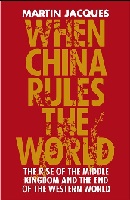
When China Rules the World

Sunday, November 1st, 2009

Intro from EUCCC:
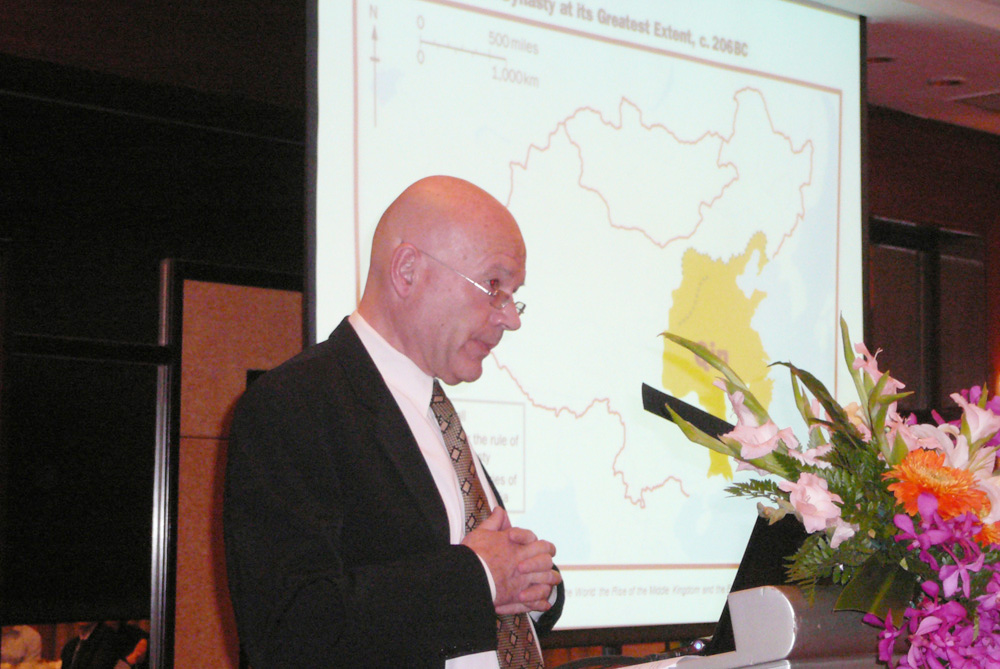
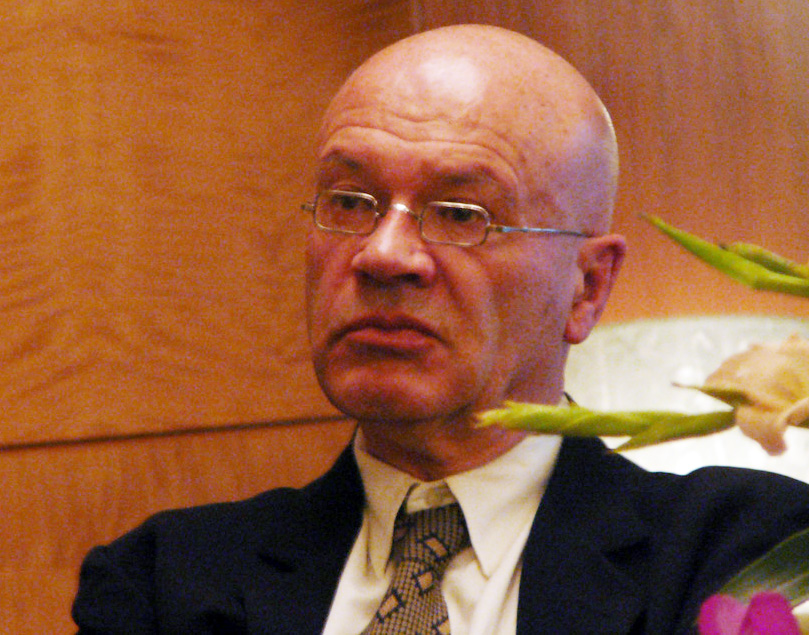
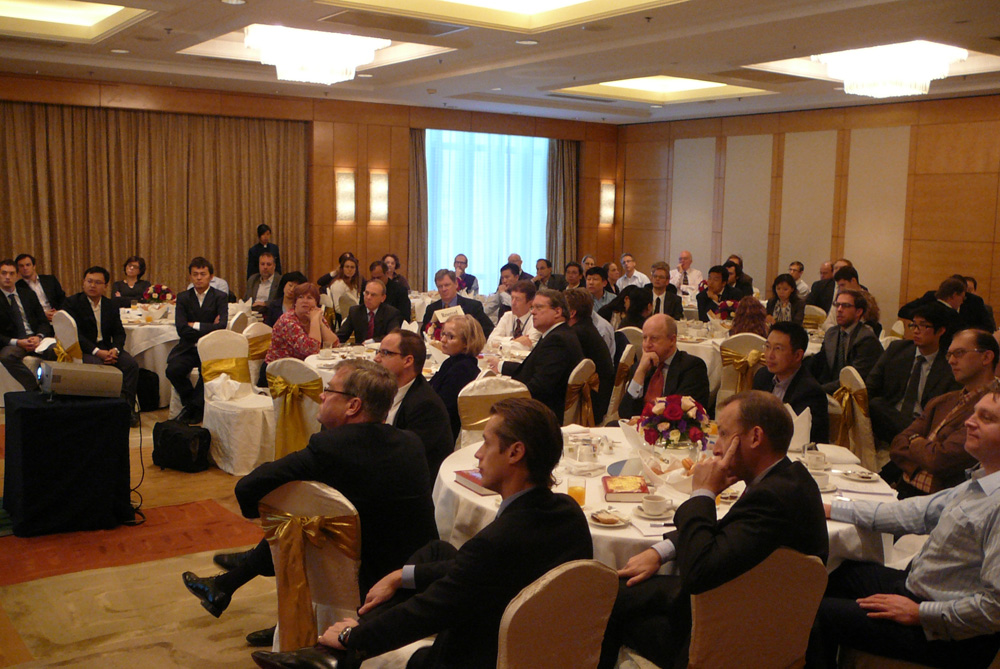
On 30 Nov 09 the EUCCC/Britcham invited author and Asia commentator Martin Jacques on the subject of his new book When China Rules the World.
According to even the most conservative estimates, China will overtake the United States as the world’s largest economy by 2027 and will ascend to the position of world economic leader by 2050. But the full repercussions of China’s ascendancy-for itself and the rest of the globe-have been surprisingly little explained or understood.
In his far-reaching and original new book, Martin Jacques offers provocative answers to some of the most pressing questions about China’s growing place on the world stage.
In this work he offers his views on how China will seek to shape the world in its own image, an image that has been shaped by a long and rich history as a civilization state.
He argues that, as a culturally self-confident Asian giant with a billion-plus population, China will likely resist globalization as we know it. This exceptionalism will have powerful ramifications for the rest of the world and the United States in particular. As China is already emerging as the new center of the East Asian economy, the mantle of economic and, therefore, cultural relevance will in our lifetimes begin to pass from London and Paris to cities like Beijing and Shanghai. This transition, Jacques argues, will determine whether the twenty-first century will be relatively peaceful or fraught with tension, instability, and danger.

About the speaker:
Martin Jacques is currently a visiting research fellow at the London School of Economics Asia Research Centre. He has recently been a visiting professor at Renmin University, Aichi University and at Ritsumeikan University, Kyoto, and was a senior visiting research fellow at the Asia Research Institute, National University of Singapore. He was editor of the highly respected journal Marxism Today until its closure in 1991. He has written for numerous influential newspapers, journals and magazines and is the author of four books of political commentary.

My comments
My friend Curt (big fan of the author!) gave me the book as a present, he signed it and I also asked the author to sign it. I only read part of it, till now.
Martin is a very good speaker; I won’t give here the full report on his presentation, only some (personal) highlights:
- China will be distinctive and different (as a world power and country); it’s a “civilization state” – agree
- China is a massive country but exceptionally unified through its long history and culture that unifies its vast population; Europe is on the contrary much more fragmented – agree
- Mandarin could become the lingua franca in the region – agree but don’t like it
- South East Asia, Australia and other countries have become very dependent on China (economically) – agree
- 95% of the population feels itself as “Han Chinese” despite the many different ethnicities – disagree, they feel “Chinese” but don’t talk in the way to feel “Han”
- the Chinese are overall not very open to different cultures – agree
- the State in China has a near spiritual role to play and in this respect has little competition; the State has a higher state competence than any other country – mostly agree
- we see the beginning of the decline of the USA as the dominant world power (nobody talks much about the EU…) and the emergence of China who however does not yet want to replace the USA in its (present) role – mostly agree (some Americans are going to like the book but could help the paranoid to call for a stronger military…)
- it is the end of the world, shaped by a Western agenda; in the past the shift was from the UK to the USA, but how will the next shift be? – probably right
- Unlike Americans (and other Westerners?) the Chinese do not ask themselves who they really are – they don’t need to do so – mostly right
- the CCP re-invented itself after Mao’s death – mostly agree
- Confucianism: state-centric and focus on good governance – mostly agree
- overall the book touches not so much on China as a society as I try in my (upcoming?) book; it’s more focused on economy and world power / international balance between the major powers.

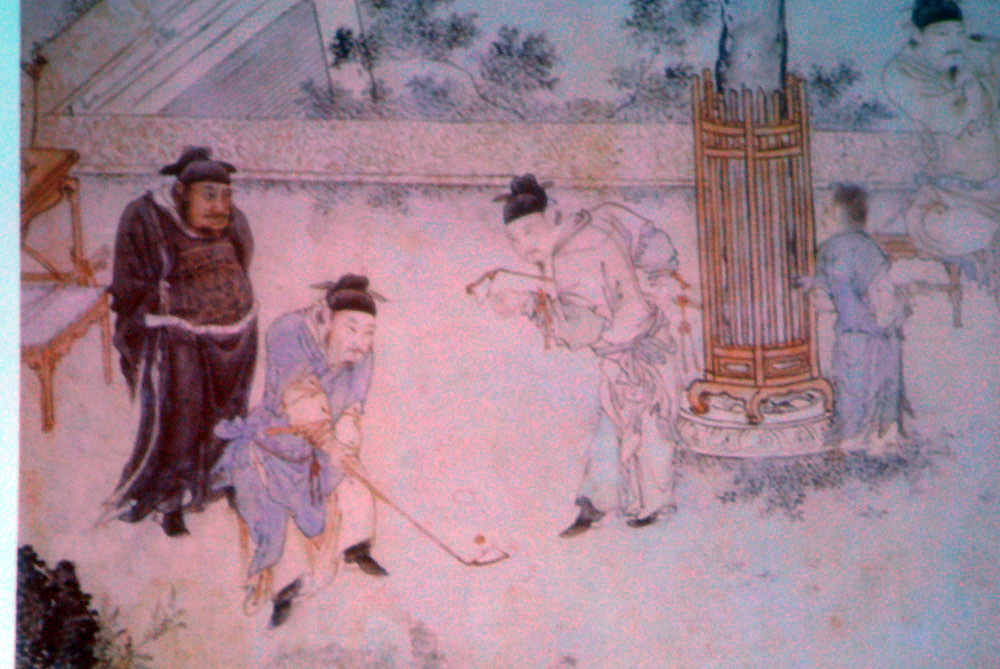
Now I still need to read the book! But I already know who invented golf…

About my book (no title yet!)

Saturday, July 4th, 2009

Since about two years at least I have been fascinated by the tremendous changes within the Chinese society. After 28 years of China I suddenly realized how much things had changed and how little I had noticed what was going on.
Most of the foreigners, even living in China since many years, have little insight in the Chinese society, the way people think, love, live and how they look at their future. Actually many Chinese also do not fully grasp the many changes in attitudes as they often live within their “box”. Others are bewildered by the sudden changes and feel uncomfortable with the new generations, called the “balinghou and jiulinghou” – the post 80 and post 90 generations. Among Chinese there is a lot of passionate debate on the generation gaps and the new trends. Chinese don’t share much those issues with foreigners as they feel this is “for Chinese only”. On the other hand they are ready to discuss with us once they feel comfortable about it. As many new trends and personal feelings are kept discreet and hidden, many Chinese and foreigners alike do not always realize what is going on around them.
The book will try to address those issues in part, much as a sociological study. It is not my aim to be complete as China has grown into a very complex society and the country is so vast with many local attitudes. The book will be focused on Beijing that is already a city full of contrasts with all the migrants – millions of them – coming from all over the country to work and live here.

The book is not without controversy as many foreigners and Chinese alike can be shocked and doubt that in China “those things exist and Chinese think and act in that way.”
Interestingly enough, my Chinese friends seem more interested in my book than foreigners – as the Chinese are more aware of the controversies.
I often jokingly say: it will not be like all the “Ying and Yang crap you hear from so-called “China specialists”.
My goal – maybe too optimistic – is to finish the draft by the end of this year. I did not even start looking for a publisher… (all suggestions welcome). First version will be in English.

I have collected a lot of information but I still need to work on it all. Currently I look at the influence of Confucianism on the society of today (many Chinese say: as good as no influence).

Keep posted!

More action on the Gongti Strip

Monday, March 30th, 2009

On 28 March 09 China Daily reported the opening of one more disco nightclub on the Gongti Strip, see the full article below, including the pic of what seems to be two “Balinghou”.
I am constantly amazed by the ignorance of some expats and local Chinese on what is really happening in the turbulent Beijing nightlife. I am writing my book on Chinese society and I mention the incredible changes in society with the new “Balinghou and Jiulinghou” generations, I am challenged by those people who often have no clue on how those new generations act and think. Not that all are the same, obviously. But a late night visit to discos in Gongti Xi Lu might be an eye opener. “We Chinese don’t go to bars, we Chinese don’t stay up so late”. Yeah. Just pop up on the Strip at 3 am and you’ll see. As for how they think, well, there are some (other) China Daily articles that might bring a light into your darkness. As I said in one of my recent articles, better to carefully check the younger graduates out before hiring them. Some can be great but some have, as the older (Chinese) generations openly claim “no any responsibility” – including at work.

Going loco @ LA Club: more action on the Gongti Strip

090328-laclub
Making a big splash in the Beijing club scene, Banana (as in GT, Coco and most recently, Babyface) has added a new hotspot to its luxury empire.
LA Club claims to be the city’s “hottest VIP hip-hop club” and hip it certainly is. From its gentle opening at the beginning of March to its scandalously sexy fetish party last Friday, the club blasts out hits from the golden era of disco and funk to the freshest hip-hop tracks of today.
The trendy aims to celebrate the full Gucci-Moet-Cartier hip-hop experience and feed selective urbanites with a taste for celebrating the high life.
With a 1971 Cadillac parked outside, and more than 60,000 faux diamonds and a rotating, elevated dance floor at its center, LA Club is sure to dazzle the eyes and ears of even the most experienced clubber. Banana’s sound engineers have a heart-thumping Turbosound system that makes you want to clap your hands and strut your stuff all night – the DJs keep the dance floor grooving ’till 6 in the mornin’.
The club plans to line up an impressive list of international artists over the coming year. It’s quickly becoming the place to grind with the capital’s beautiful people. If you’ve got money to burn, you’ll definitely want to try out one of the revolving, ultra-deluxe VIP booths, where you can sip on gin and juice, indulge in bottles of Mumm Champagne (at 580 yuan a time), or the two-for-one mixed drinks. LA Club signifies a new height of Beijing clubbing. Hip-hop hooray!
West Road of Workers Stadium, next to COCO Banana.
Story by Carissa Welton, photos provided by LA Club