Beijing newspapers guides: outdated

The English language newspapers in Beijing are improving and add more content. But when run by Chinese only, they remain a bit unreliable and outdated.
“Beijing Weekend” (China Daily) is a good case. Nice layout and colorful. But don’t trust their listings…
– “The Hidden Tree”: the popular Belgian bar has been renamed “The Tree” since years
– If you follow the directions to “Bus Bar” and “Nanjie” you’ll end up in a meters deep crater where both stood once, in front of the Workers’ Stadium; as reported earkier in this blog, they moved time ago (fortunately for them);
– “Browns”: as far as I know, closed since long with its owner vanished.
– “Babyface”: good luck if you wanna dance there. In the process of being demolished, hopefully to re-open one day.
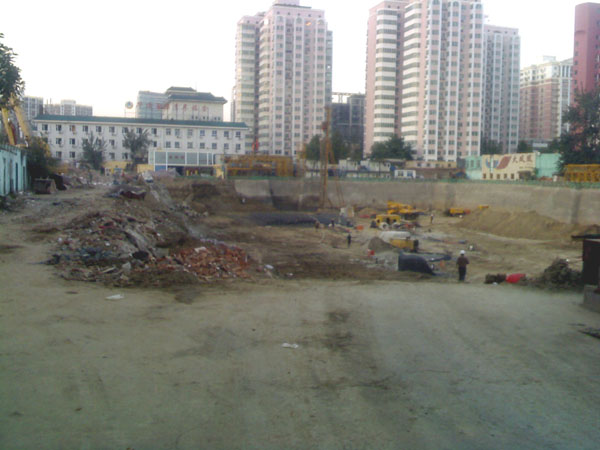
click to enlarge
welcome to Bus Bar and Nanjie (pic taken 12 Oct, one week before the mentioned publications)

“Beijing Today” also just published a so-called “Chunxiu Lu” Guide. They too lead us directly to the huge construction site to have a beer at Bus Bar and Nanjie. They left out several other well known entertainment and health venues in the area. The same happened when they explored the Gongti Xi Lu area where they missed some famous spots.
Maybe the Chinese reporters don’t have the stamina to visit so many bars and get tired. Too much rice, too little Belgian beer and juicy steak.
Compare that to the other publications like That’s Beijing, Time Out, City Weekend. Can’t beat those.
That is actually a major problem with many Chinese “Guides”: incomplete. A major issue I brought up with the city government who tries to guide the visitors for the 2008 Olympics. I suggested they pick up a copy of That’s Beijing in Morel’s Restaurant or The Tree. After a Leffe beer, of course.

2008 Olympics: the quest for tickets, hotel, etc.

On 4 Sept 07, Bencham invited Olivier Carteret, CEO of ARISTEIA Sport Communication to explain how they handle the sales of tickets and packages for the Beijing Olympics.
Aristeia has been appointed as the exclusive supplier for tickets in France, Belgium, Luxembourg and Monaco. That means, if you live in those countries you must pass through them. Don’t even think of trying to get them here directly.
The turn-out for the presentation was a bit low, a real pity as it was a lively presentation and discussion.

click to enlarge
Olivier introduced by Bencham, Rini Quirijns

Again, Bencham members received the electronic copy of the presentation.
Olivier explained that many people, especially working in Beijing, still have some illusions like they will be able to get, for the period of the Olympics, airplane tickets, restaurants and venues for meetings and hospitality, transportation, tickets for their guests, etc.
Some companies tried but had to get back to Aristeia six months later as they had failed to get what they wanted.
Aristeia is working very closely with BOCOG to secure hotel rooms, transportation and of course tickets for the competition events.
One of the issues Aristeia has to deal with is securing competent staff, so they do in-house training.
They have a wide range of packages, for the normal tourist up to the demanding corporate client. But the more you ask for, the more you’ll pay and it won’t come cheap.
You are warned also – better just stick to the officially appointed agencies like Aristeia, don’t trust all those fancy offers.
One of my concerns is that many of the food & beverage outlets as well as entertainment venues will not be open to the public, either because they are not allowed or able to operate or because they will be taken over completely to handle corporate hospitality. Olivier confirmed at least in part my concern.
Another controversial aspect, not discussed in the seminar, are the “National Houses” planned by many countries (and even Chinese provinces). Some of those countries might face some unexpected bureaucratic hurdles I won’t explain here…

EU: “China Getting Tougher for European Business”

In an earlier posting I reported on the EUCCC Press Conference. I found the following article by Gary Bowerman, dated 15 September 2007. It gives a good overview, taking over the comments from the EUCCC.
Published in : The News, News September 2007. Source: www.bizchinaupdate.com
European firms are facing a toughening business environment in China, according to Joerg Wuttke, President of the European Chamber of Commerce in China.
Launching the EU Chamber’s 2007 European Business in China Position Paper, Wuttke said: “The investment climate is becoming more complex and challenging for foreign businesses operating in China,” adding that “companies in some sectors face new or increased requirements in areas such as technology transfer.” In addition, the transfer of technology mandated by Beijing, “threatens the core of European business … if you let go your entire technology,” he said.
Wuttke also highlighted the finance and telecoms sectors, where domestic competitors still enjoy state-protected competitive advantages. “We are seeking a non-discriminatory investment climate,” he added. “We seek fair and impartial treatment.”
The 2007 EU Paper identifies technical barriers to trade and investment, such as: “homegrown standards, the lack of adoption of international standards and arduous approval procedures”.
Below are the published highlights of the 2007 EU Chamber Position Paper:
Recent Positive Developments

  • Two-way trade between EU and China has grown by 21.6% in 2006, exceeding EUR 250 billion.
  • Large scale economic reforms in most sectors.
  • Continued European investment into China, over EUR 3.7 billion in 2006.
  • Improved consultation in the drafting of certain legislation such as the Labour Contract Law, the Property Law and the ongoing work on the Patent Law and Energy Law.
  • Promulgation of new legislation, including China’s first Anti-Monopoly Law.
  • Opening up of the banking sector to foreign participation; reduction of capital requirements.
  • Intensified efforts on energy saving and emission reduction, and the publication of the national action plan on Climate Change.
  • The introduction of National Phase III emission standards (similar to Euro III) for new vehicles nationwide.

Challenges

  • Emerging trend within some regulatory bodies towards unequal treatment of foreign companies through protectionist measures.
  • Continued lack of effective deterrence against IPR infringements.
  • Need for greater consistency, implementation and enforcement of laws and regulations, particularly at the local level.
  • Continued limitations on investment in certain industries such as automotive, telecoms, petrochemicals, and energy.
  • Technical barriers to trade and investment in the form of home-grown standards, the lack of adoption of international standards and arduous type approval procedures.
  • Sufficient time should be granted between the promulgation and the effective date of laws and regulations.
  • Forced technology transfer for participation in certain sectors.
  • Lack of independent regulators in certain sectors, which results in the lack of effective, transparent and independent decision-making.
  • Distortions in energy prices that discourage energy saving and greater dissemination of advanced environmentally friendly technologies.

30 August 07 – Bencham and the new Labor Law

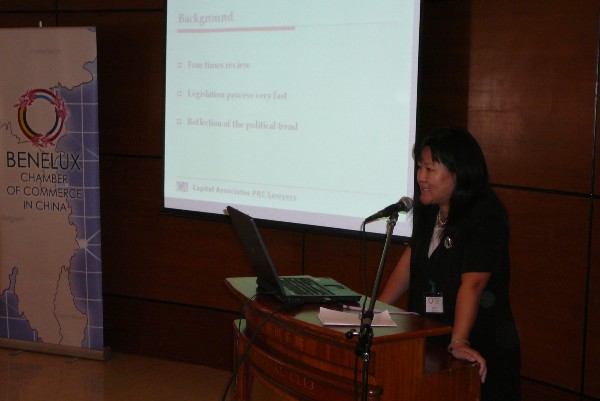
The Benelux Chamber of Commerce (together with the Danish Chamber) invited two speakers to give their insight into the new law: Ms. Luka Lu, Lawyer and Managing Partner for Capital Associates and Mr. Paul van de Kerkhof, Managing Director Randstad China. Both gave good presentations and Bencham members received their presentations in electronic form.

click to enlarge click to enlarge

Luka Lu and Paul van de Kerkhof

Many foreigners are not yet aware of the changes this law will bring – they better get an update because it is going to change a lot how companies handle their Human Resources.
Several clauses of the law will need further clarification. The final version is more balanced than the earlier drafts. One provision that was changed is regarding the ceiling for liquidity damages in relation with the non-competition clause – very reassuring because the former draft left the door open to stealing employees along with their expertise and technical secrets without due legal ways to stop it.
Overall the law seems to be made more for blue collar workers than for top execs. The question is, will China really enforce the rules for those workers who are regularly badly treated, mostly by local Chinese companies.
The law will result in higher HR costs but will make it more easy to fire top level staff.
Outsourcing of staff as done in western countries still is much a grey area, the least to say.
I found the following overview interesting, source: FIDUCIA. Gives a flavor of what it is all about.
New labour law regulations

  • Employers are required to sign written contracts. If within one month, no written contract is signed the employers have to pay double salary. If within one year, still no contract is signed, an indefinite contract is deemed to be signed.
  • Each employee can be offered a maximum of two fixed-term contracts. The third contract will be considered
  • as indefinite.
  • Employees who have worked for the same employer
  • for ten years are entitled to an indefinite contract unless they request a fixed-term contract.
  • The length of the probation period is linked to the duration of the contract and only applies once.
  • Salary during the probationary period cannot be lower than 80% of the salary after probation.
  • Labour unions have the right to negotiate contracts and company policies with employers on behalf of employees.
  • Changes concerning hours, safety, insurance and allotment of holidays must be submitted to the employee
  • representatives for discussion (this regulation
  • already applies for labour union members).
  • Employers are limited in their demand for training cost repayment when staff leave before the end of their contract.
  • Employers are forced to pay severance if they do not renew employees’ fixed-term contracts, unless they can state a valid reason.
  • The non-compete obligation is limited to two years and only applicable for senior management and technical personnel and other staff who are subject
  • to confidentiality obligations.

Be warned…

Sex in dacity of Beijing

People get curious about what’s going on in China, “behind closed doors”.
Well, the Beijing police (see earlier posting 2 Sept) is trying to improve the morals of its citizens. This is a periodic occurrence, much like influenza. Caused yearly by the upcoming party congress (this month) and by the 2008 Olympics. No more monkey business and doors should not be closed anymore – massage (a VERY wide definition) rooms should be unlocked and have “transparent windows”. Yes, yes, we all know, the city of Beijing is famous for “transparency”.
Promptly, raids were done on some of the sauna houses and other “entertainment” venues, creating fear among the staff and drug withdrawal symptoms with the addicted customers (no dude, not “those” drugs). No problema, I was told by well informed sources, all swell again, business is normal, people need to make a living.

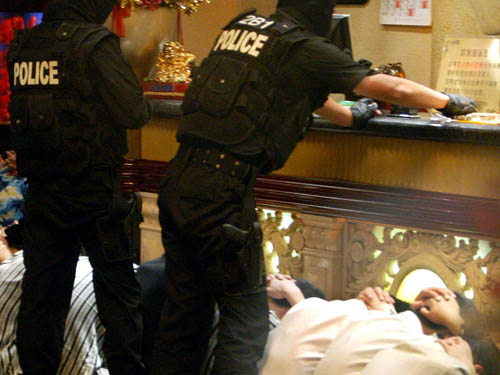
click to enlarge

See here pic of SCMP dated 2 September, one of the raids; the police even has English vests. Unlike the crew that beat up some black people walking in Sanlitun recently – no pics coz all cameras and mobiles were promptly “cleaned”.
For the naive sort who allege prostitution and suspicious activities are illegal in China: right. So they are in most countries. Good we have the USA embassy here and the website That’s Beijing (see my favorite links). See here some extract from their website on 7 September (I have the full article, exciting reading I can assure you):
==
Massage City.
It doesn’t mean that Beijing is prude. Quite the contrary is true. Sex is as available in Beijing as Chinese food. Sex for eat-in, sex for take-out, sex for home delivery. There are even restaurants where you get a massage when you pay the bill. There are neighborhoods where every barbershop routinely relieves you of excess hair and of undue tension in your male organ. No hotel bar is complete without a complement of willing females. And if you forgot, there is a card on the nightstand that reminds you of massage services. For a tip with happy ending. If you think that at the many foot massage establishments only feet get massaged, think again.
According to a study published by the US Embassy to China (your tax dollars at work … imagine the research) they estimate “that Beijing has at least 200,000 – 300,000 prostitutes.” What’s more ,”the contribution of the ‘sex industry’ to the GDP comes in at about 12.1 – 12.8 percent,” the study claims. In case you want to get in on the booming business, the embassy links to an excerpt of Pan Suiming’s book “Red Light District,” published at the UN China website. This book is a proverbial business manual to setting up a sex business in China.
You can rent a girl by the hour, for the night, for a day, or for the length of your stay. The savvy businessman hires an “assistant” for a week or two, she provides sexual favors and if she’s really good, then she can provide secretarial services, or tell the taxi driver where to go.
==
Anybody not convinced or ill-informed, I organize all kinds of seminars and guided tours. ANY topic, not only that boring story about the preparation for the 2008 Olympics. Comes at a price tough! Experts wanna be paid. Of course as said you can simply navigate to “That’s Beijing”, it’s free and you don’t need anybody to help. There goes my business model.