Some days (actually most days) I just wonder why I still care about the 2008 Olympics. Very frustrating really, seems all a total waste of time. No wonder I am taking it VERY easy right now.
Foreign companies bug me with the silliest of ideas and inquiries. They want to sell special eggs for athletes to eat (kind of wonder eggs), small toys to make a clicking sound to cheer up the teams (the sample promptly cut Sun’s finger – Chinese like big stuff they can swing around with flashing lights), etc. etc.
They all expect I am going to make their dream happen at once, just a simple phone call. Well, those inquiries demand lots of work and normally don’t even pay for my taxi.
I am also tired of those endless seminars, every year they talk about the same golden opportunities of 2008, the for certain golden post-Olympic future, etc. etc. Experts give advise, nobody really cares once the seminar is over. One year later, the same scenario.
Now, when you need to contact anybody within BOCOG, good luck. Their “general number” does not work, is officially not even listed in the directory (is on their website, for decoration purposes). So, if you don’t know the direct number, you’ll have to pull all strings to find anybody. Furthermore, most of the staff does not bother to answer e-mails or even pick up the phone. Unless you know them well.
You see, all so easy.
Not that all BOCOG staff are a bunch of useless morons. Not at all. They have their own internal nightmares, like a lack of: real efficient management / decision-making power / budget / competent staff.
Wait a moment: not enough good people? But everybody wants to work there. Well, I was all happy to learn that it is tough to get real good people for the reasons I am tired to explain:
Returning Chinese claim to have excellent qualifications. The fact is, the vast majority does seem to speak some good English but fail miserably in writing skills; they also forgot their own language – Chinese – and fail Chinese language tests. Fresh graduates from local language universities end up being much better – but lack experience for other matters. That is the wise and confidential feedback from BOCOG executives, frustrated. I fully sympathize.
The number of “turtles” or “bananas” coming back to China that are pretty bad in English is staggering. They can’t write one sentence without mistakes. Worst, they often think “they made it”. Yeah. Show me.
So, wanna contact the IOC representative in Beijing? Well, forget that too. Telephone never answers (probably the number is intentionally wrong on the business card). E-mails are received, never answered (not even like “sorry, can’t help”, “bug off”). I guess we poor Beijing mortals are way too low in the scale to be dealt with.
So, if I have questions about ambush marketing, I will not ask them anymore. Maybe we should not even care and all use (free) Li Ning T-shirts (or KANGTA or others), attend the Games and parade in front of the cameras.
Sorry folks. Some days really p*** me off.
Better in Beijing than in … Putrajaya
Complaining about China? This can make you feel better. No place is perfect.
May 2007 – A “Muslim-born” woman converted to Christianity and was baptized in 1998. A court in Putrajaya (Malaysia) denied to have her ID card changed to remove the word “Islam”. Result: she cannot marry her Catholic fiancé and is ostracized. (Of course she cannot do many other things, like drink alcohol, etc. No glass of red wine for her). She is now considering fleeing the country for better pastures. So Malaysia has its own caste system, you are born with it, you die with it. Religious intolerance. Maybe the next step will be to stone her? Mind you, the date is correct. May 2007.
Behave! Lu-Chin Mischke speaks out
On Saturday 2 June I went to Lu-Chin’s presentation of her book “A guide to Bringing out the Best in Yourself”, organized in the Hilton Hotel – space graciously provided by our good friend Vlad Reyes (a Rotarian, by the way). She made also a presentation in our Beijing Rotary Club where she is a regular guest.

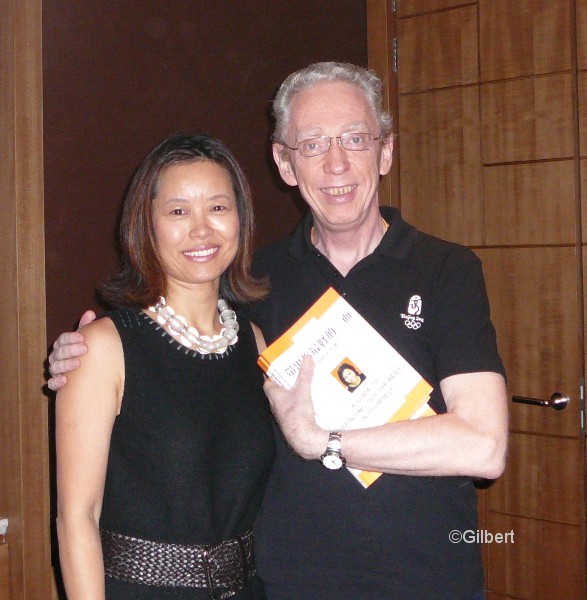
her book – Gilbert with the author
You can call Lu-Chin Mischke our Ms. Manners, local version. She set up the Pride Institute and has been bugging me (nicely) since some time with her relentless campaign, trying to educate our Chinese friends, like no spitting, no littering etc. Tough job and she has endless enthusiasm that I admire. Against all odds (OK, that me speaking, so don’t pay attention) she has been scoring some nice success and raised a lot of interest in the media and with Chinese officials. I think she must have some stubborn Flemish blood in her veins… She really never gives up and still sports a big smile (you are Ms. Manners or not).
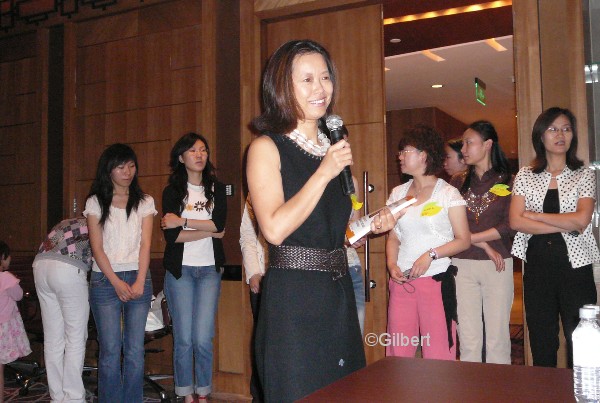
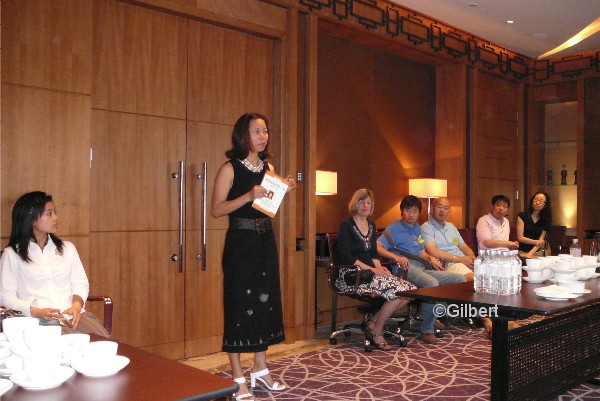
Ms. Manners in action
I bought several copies of her book, all in Chinese (obviously), to give out to some people. The one she signed for me I’ll keep of course. Pity I can’t read it, maybe I really need better manners too?
If you want to know more, see her website: www.prideinstitute.cn
And: behave! Watch your manners!
Gilbert lost in translation and 3 million cars in Beijing
The Olympics are coming, everybody is learning English, the city is becoming truly international. OK, that’s the official version Beijing wants us to believe but I am still looking for that unique taxi driver who can speak any usable English.
As for the “10th China Beijing International High-Tech Expo”, held in May, I fail to understand the word “International”.
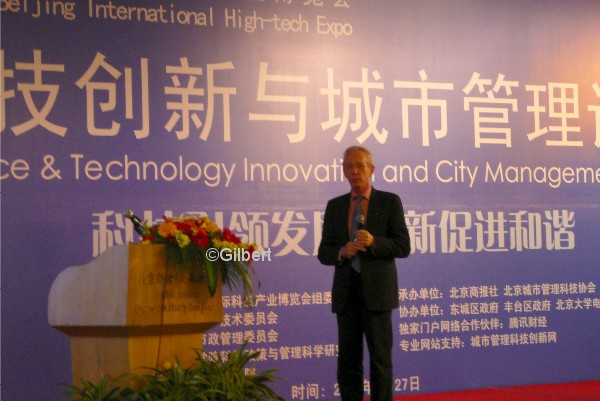
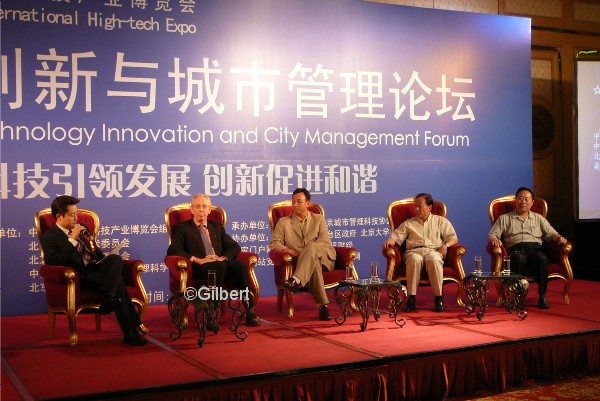
I was dragged, without too much enthusiasm, as a speaker into the “Forum on Science and Technology Innovation and City Management” (Sunday 27 May). For sure here the term “International” was all my fault as I was the only foreigner (long-nose type) in the vast conference hall (300 people target audience). Understandable, who wants to go there on a Sunday afternoon.
I was asked to give a 15 minutes speech and it was “confirmed” there would be simultaneous translation. But why have translation for the one ignorant foreigner, right? Panic. Please keep it to 15 min. I flatly refused, I had prepared my 15 min PPT and that was it, no time to cut half. So, I took just over 30 min with the translation and left some Chinese fuming (too bad for them).
Finally we had a “panel discussion”. By then, all had gone home except for some lonely journalists. The poor guy/girl from Beijing Today must have been very sleepy or very poor in English – probably both. Messed up great and I was shocked (= exaggeration, I don’t care anymore) by the nonsense he/she wrote. See below the original text as posted on their (horribly poor) website that was recently “improved” (now worse).
So, don’t believe a word of the crap they published.
What I DID say was (part of my PPT):
“Traffic – drastic measures needed”
The main cause for pollution and the deteriorating health of Beijing’s citizens: too many cars, too much chaos on the roads. Beijing needs the courage to stem private transport and to impose traffic order. Remove cars parked everywhere, limit parking except for indoor parking lots. Improve respect for traffic rules, respect for pedestrians and cyclists – and the disabled.
Also the “lindao” must obey the rules. Better traffic police – who really IMPROVE traffic.
In principle the reduction of cars and the special Olympic lanes will guarantee good transportation. But some have concerns about the overall traffic coordination and logistics, as the venues are spread all over the city.
The massive construction of the many metro lines is promising but there needs to be more coordination between the different metro lines and other public transport such as bus lines. Also, transfer stations have to be improved to be more convenient.
Metro stations needs modernization, e.g. some go very deep and have only escalators going up. (The only thing the journalist got right!).
What they printed: 1 June 2007 – Registered vehicles hit 3 million
By Chu Meng – Beijing Today
The number of registered automobiles in Beijing hit three million on Saturday, causing tremendous pressure on the city’s existing traffic system and environment, a traffi official said in the 10th High-tech Expo this week.
“This number reflects the capital’s economic and social development, but at the same time, it poses new problems,” Liu Xiaoming, deputy director of the Beijing Munial Transportation Commission, said.
Statistics show that 30.2 percent of Beijing residents travel by bus and 29.8 percent drive cars, Liu said. “The rapid increase in the number of privately-owned cars and decrease from1.52 persons per car to 1.26 persons per car is not conducive to energy conservation,” Liu said.Statistics show that the number of newly-registered automobiles in Beijing is growing at a rate of 1,000 a day, and the total number will reach 3.3 to 3.5 million by August next year, when the Olympic Games begins.
As a short-term measure for the Olympics, it has decided to restrict the access of more than one million vehicles, particularly those belonging to government departments and state-owned enterprises, to alleviate traffic congestion and improve the quality of air during the Olympics Games.
Liu said that as many as 45 percent of the residents are expected to use public transport by 2015.
Gilbert Van Kerckhove, chairman of Public Procurement of the European Union Chamber of Commerce in China supported the plan, but noted that it was an unusual to providing special roads for athletes and artificially control traffic during the Games.
He said that the Olympics would bring legions of visitors, but what worried him was transportation after the Games.
“I think that checking into hotels i Beijing will be difficult because they are so spread out. It will be difficult to coordinate transportation. There will be many subway lines built in the next three to five years, but relying on the subway is not the best method. To make the transport system convenient, we must ensure that transfer stations are trouble-free,” he said. He also pointed out that most of the subways only offered an escalator that goes up, but not down, making them impassable for the handicapped.
So, what other stuff did I say? Sorry you missed that. Like… what will happen to Gongti Xilu (Babyface, Destination) during the Olympics…
The hutongs of Dongsi Batiao: the saga goes on
Interesting to read the official press, see copies: article from China Daily (30 May) and another from Xinhua (28 May) that was on China Daily’s website. As you can see, not clear yet. At least it is reported in the official media, a step forward.
I was also interviewed on the subject by China Radio International, for my weekly stunt around the Olympics. here’s basically what I said – my official position:
– the saga is bad for Beijing’s image because of the confusing and conflicting declarations; either the hutongs are worth protecting and are registered as such, or they are not; if this is done correctly the authorities should immediately intervene and clarify the situation; the uncertainty generates bad press and everybody will remember it as “Beijing destroys the hutongs for money”;
– hutongs and siheyuans should be checked by experts (real and neutral ones!) to evaluate their historical value and how they should be renovated and preserved;
– many so-called hutongs are just shanties good enough only to be bulldozed; some of the inhabitants just want to get as much money as they can and are ready to make a fuzz to get it;
– renovation should be assisted by specialists, too many restorations have been badly done, destroying the original structure or using the wrong material (like happened before in the Forbidden City until they went back to… pigs’ blood);
– many people, foreigners and locals alike are ready to do a good restoration job and should be encouraged by all means – it can only help to preserve as much as possible the spirit of old Beijing.
And if you wanna know, I am myself not a fan to live in a siheyuan. I find most very uncomfortable, with bad insulation during winter and summer and one gets eaten alive by the pesky mosquitoes in summer and or gets exposed to Beijing’s merciless pollution. That may be good for insect lovers and people with stainless steel lungs and skin.
30 May 2007 – Preserving our hutong (China Daily)
The old city renovation project in Dongsi Batiao tests the municipal government’s management ability, says a signed article in Beijing News. An excerpt follows:
According to the Beijing Municipal Commission of Urban Planning, the Dongsi Batiao relocation project is temporarily suspended.
But Vice-Chairman of Beijing Municipal People’s Political Consultative Conference Wang Changlian said recently that active protection of the old city proper, or a combination of protection and utilization, was necessary.
Authorities of the Dongcheng District said that there are no certified or registered cultural relics in the demolished part of Dongsi Batiao so the area has no value for protection.
Beijing has demolished much of its old city proper since the 1990s. The result is that traditional streets and houses are gradually disappearing. Only some royal palaces and gardens are well preserved.
Against such a background, we should try our best to save more areas of cultural and historical significance. Passive protection, or preservation, is justified and necessary. And this is the very reason that the Dongsi Batiao project stirs many.
The discussion over the renovation of Beijing’s old city proper has continued for about half a century. It is pathetic that people are still disputing whether hutong (alleys) and siheyuan (courtyard houses) are worthy of protection today when these traditional areas are rare.
The protection of Beijing’s old city cannot be decided by the district government or the real estate developer. Besides, it tests the government’s ability to deal with social disputes.
A democratic procedure and wide social participation are needed. Involved departments should hold a public hearing on the project to solicit opinions and explore solutions.
28 May 2007 – Demolition suspended of Beijing ancient hutong (Xinhua)
The controversial demolition of houses at Dongsi Batiao, an ancient alley of courtyard homes in downtown Beijing, has been suspended, an official with Dongcheng District government has confirmed. Suspending demolition, however, doesn’t mean the redevelopment project has been terminated, the official said.
The official said the demolition office will continue negotiating with local residents over the amount of compensation they will receive.
By Saturday, only the No. 9 courtyard in the hutong or alley had been bulldozed and fewer than 10 of the 80 families in the neighborhood had moved.
Dongsi Batiao, which literally translated means the eighth hutong in the Dongsi area, was first developed some 700 years ago during the Ming Dynasty (1271-1368). It has been listed as one of the capital’s 25 protected historical sites.
The redevelopment plan has been criticized by historians, experts and in editorials that point out the area is one of the city’s 25 protected historic sites and should be preserved.
Other courtyard homeowners such as Xia Jie, a folklore lover who has grown up in Dongsi Batiao and owns a 500-sqm siheyuan or four-sided courtyard, wants the redevelopment project permanently halted.
“Hutongs are the soul of Beijing. They must be preserved.” Xia, who has petitioned the government and is awaiting feedback, was quoted by the Beijing Times as saying.
However, local newspapers say that many of the local residents with no property rights of the courtyards are eager to move but upset with the compensation, with the lowest at 8,090 yuan a square meter.
“We can’t wait to move. Who said this is cultural relics, please come to my place and see for yourself,” said another resident who had lived 17 years in a shabby one-room shack.
Some residents say these traditional houses lack sufficient sanitation such as flushing toilets, bathrooms and are in unsafe condition. They deemed it’s a good chance to improve living conditions but the compensation is not enough to buy an apartment downtown where housing price can be twice as much as the compensation for per sq m.
The owner of the No. 9 courtyard, said she was satisfied with the compensation. The developer paid her more than 20,000 yuan for one square meter because the courtyard is her private property.
Bai Hua, deputy manager of Zhong Bao Jia Ye Property Development, would not confirm that demolition had been suspended as he had not received formal notice from the government.
The housing administration of Dongcheng District published an announcement in February saying two hutongs, the eighth and ninth of Dongsi, would be demolished.
The authority posted another notice on April 15, ordering all the residents to move out before May 26.
Covering an area of 80,000 square meters, the redevelopment of the area was approved by the municipal urban planning bureau in 2001 under the name of “renovation of endangered historic areas”.
Liu Qifei, an archaeologist and a member of the Beijing Municipal Committee of the Chinese People’s Political Consultative Congress, the local political advisory body, appealed to the municipal government in late April, asking that the project be stopped.
Liu also said the departments in charge of the project should be reprimanded for damaging the city’s image as an ancient capital.
The hutongs, traditional networks of small lanes and courtyards, have been rapidly vanishing in recent years as Beijing modernizes, triggering outcries to safeguard the city’s unique heritage.