The past couple of days left me frustrated with the OFFICIAL website of the 2008 Beijing Olympics. Poor job really but all in line with Beijing’s normal characteristic: bad PR (public relations). Who is to blame, I don’t know. Maybe Sohu (who is the webmaster) or is it BOCOG who does not provide the information. Probably both.
Be sure that, whatever you really need to find, will not be there. The search function sucks and normally will NOT give you anything you were looking for. Some of the information is good – others are poor, non-existent or out-dated. But it looks “flashy”.
The website of China Daily might not be perfect but usually I manage to retrieve what I need, using the headline of the article (from the hard copy I read). Except for the “Olympian”, the weekly supplement. Again, many articles are unavailable and forget the search tool.
Three examples:
1. marketing program: scarce or zero information on who was appointed (when? for what?) as Supplier or Exclusive Supplier. E.g.: STAPLES. Don’t even search for it – result is zero. Also Johnson&Johnson appears twice. Great. I complained, no reaction. I also criticized publicly the presentation: many Chinese company logos are… in Chinese only. Clicking the logos you go to their website and … don’t hold your breath. Most have no English (most of the links are broken) and many don’t even explain clearly what they do and what is their involvement in the Olympics.
All not important – except if those companies have the illusion they want to use the Olympic sponsorship to make their brand “world famous”. Good luck. Go and look for yourself… After I complained (to the great shock of the journalists) they put some explanation on the website that promptly disappeared again.
2. “Olympic Schools” or “Olympic Education Model Schools”: just try to find out anything about that. Zilch. Fortunately I found a hard copy of “The Official BOCOG Newsletter”, Issue 29, June 2006. It’s all in there. Wanna know, pay me. (Took me several days to find out what I needed!)
3. The Brochure I mentioned: in the past (the old website), you could retrieve all previous Newsletters in PDF. Well, bad luck, no more. Including that very issue I needed. So, I can maybe scan it myself (16 pages…). Asked a friend at BOCOG, see if she can solve my riddle. I keep you posted.
Long way to go really. Pity for the staff at BOCOG – some are really doing a great job and have to endure a lot of difficulties in their daily work.
China Daily (again) – no more clothes needed

Gilbert in China Daily
Well, surprise. I never thought they would publish my letter (see previous entry). See here how it came out 🙂
“Letters and Blogs(China Daily 22 May 2007 page 11)
Protect the hutong
Comment on “Calls for halt to demolition of hutong” (China Daily, May 15)
Thumbs up on the reporting on the destruction of Dongsi Batiao hutong.
As senior advisor to the Dongcheng District I feel ashamed to see the district not intervening in this matter.
I hope your article will draw some attention, otherwise it will be once more proof to the foreign media that Beijing is destroying its heritage for quick real estate gains, or worse, for the Olympics.
Gilbert Van Kerckhove”
Near Julong Garden: lots of fire trucks and smoke
On 19 May, in the afternoon I looked out of our window in Julong and first thought Tian He Mansion next door was starting up their air conditioning tower. But is wasn’t water vapor… it was fire. Went to have a look at the many police cars and fire trucks, but not much to see really. Well, better than to see flames all over.
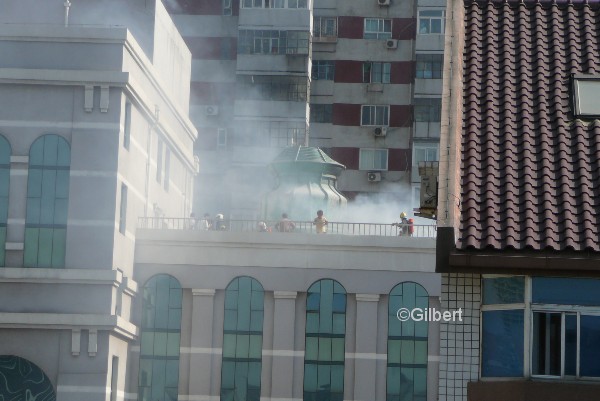
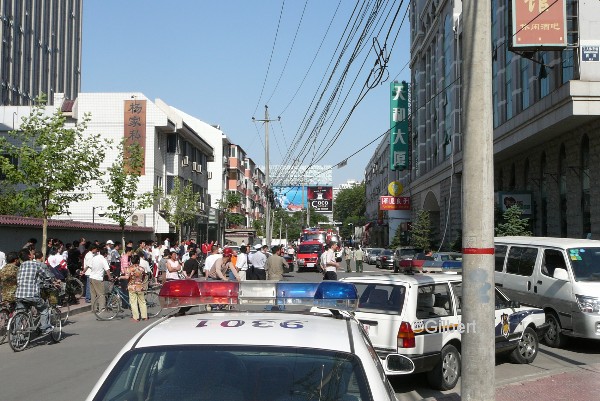
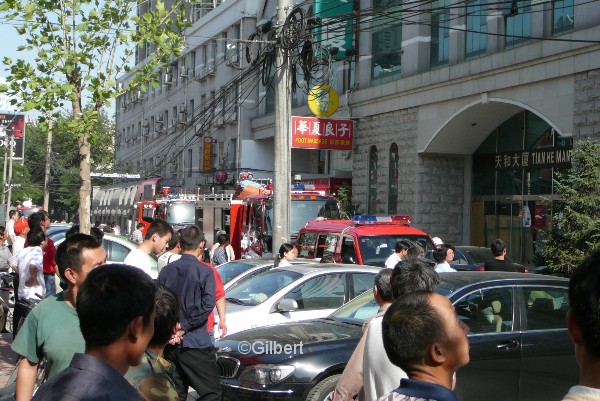
Good it was Saturday and traffic was light… and it wasn’t in the evening when Gongti Xilu becomes a big mess of cars (you can see Coco Banana in the pics).
Is Beijing really protecting the hutongs?
China Daily and the local Chinese press are venting frustration about the mess in Dongcheng District. No need here to tell the story, see what China Daily wrote on 16 May on the Editorial Page:
“Save our hutong”
Years back, when Beijing’s municipal authorities pledged to respect the city’s architectural legacies in urban renovation, we celebrated that precious, though belated, wisdom.
As the Beijing Olympics organizers challenge themselves to present the city’s and the country’s cultural splendor, we shared the innocent hope that more of the increasingly scarce hutong traditional alleys and siheyuan traditional quadruple residential courtyards would survive the city’s urge to put on a new face for 2008.
But such hopes were smashed yesterday as workers began to pull down buildings at 9 Dongsi Batiao, a government-designated area for protection.
Local residents tried to stop the demolition, but in vain. Nor did conservation advocates’ and cultural relics protection departments’ passionate objections work.
A notice posted by the developer says buildings in 26 old courtyards on Dongsi Batiao will be demolished by May 26.
We disagree with extreme conservationists who want everything old to be preserved. But the municipal authorities must not play the indifferent onlooker when the city’s cultural identity is being squandered.
The Dongsi Batiao area, an important part of old Beijing, is among the first 25 areas of cultural and historical significance the city has promised to preserve.
But now, 26 courtyards will be gone in less than two weeks. And there is no sign that any powerful office of the municipal government will step to halt the demolition.
The local bureau for the protection of cultural relics did express disapproval. But it is not in a position to stop the demolition.
While the public questions the city’s messy chain of command – with different parties quoting divergent authorizations – we are more concerned about the immediate fate of the endangered courtyards. Once they are gone, they are gone forever.
Of course developers can build replicas. They are quite addicted to that.
The city government has just inaugurated an expensive project to renovate the historical Qianmen area. The idea is to recreate the architectural look of the late Qing Dynasty (1611-1911) and early Republican years (1911-1949).
But it will be a shame if the genuine heritage is destroyed.
End of their article.
I sent the following letter to China Daily on 17 May 07 (not expecting any publication):
RE: Save our hutong – 16 May
Thumbs up for the transparent reporting on the destruction of Dongsi Batiao. As Senior Advisor to the Dongcheng District I feel ashamed to see the District not intervening in this matter. I often defend the Beijing Government who has tried to protect old buildings within the 2nd ring but this story makes a mockery of Beijing’s Government. I hope your article will draw some attention, otherwise it will be once more a proof for the foreign media that Beijing is destroying its heritage for quick real estate gains, or worse, for the Olympics.
Now wait and see how the story will end… But I not so optimistic.