Finally all submarine cables are repaired and we are back to normal. The Chinese Great Netwall is continuing its job relatively well as they have now mastered the bugs in the CISCO equipment that elegantly blocks certain sites, according to some “badly informed people” (read: the whole foreign business community in Beijing)
Indeed the government genius representatives in Geneva have now passed their PHD in information obfuscation, at the G. W. University in Washington DC. Here some gems:
“In China, we don’t have software blocking internet sites. Sometimes we have trouble accessing them. But that’s a different problem.” – Yang Xiaokun, China’s representative to the UN’s Internet Governance Forum in Athens, denies censorship in a BBC interview as reported early 2007 by DigitalMedia.
Tuesday 31 October 2006 – The second day of the Internet Governance Forum (IGF) was partially strange, partially funny, and indeed quite productive.
The day began with a main hall session about “Openness”, ….. As one might imagine, a panel about openness and transparency on the internet did create quite a bit of China bashing, and while Mr. Art Reilly, senior director of strategic technology policy at Cisco Systems, had a hard time explaining the exact dealings of Cisco with the Chinese government (Yeah, I guess that’s really hard!), Vint Cerf made some clear statement for Google in terms of being transparent about filtering on request of the Chinese government, but trying to avoid to gather data that could be abused: “Let me also say that we also chose not to offer certain services in China. We didn’t offer Gmail. We didn’t offer blogging. The reason we did not do that is that we did not want to have materials on our servers that the Chinese government could ask us or insist that we reveal in order to identify individual parties. So we chose deliberately not to offer certain services in order to protect the interests of the Chinese people.”
So when Mr. YANG XIAOKUN of the Chinese mission in Geneva stood up after a long discussion about the subject to tell the assembled audience that China has no access restrictions of any kind, it did draw some unbelieving looks, and then some boos. Here is that part of the exchange:
>> NIK GOWING: Could I — may I ask you a question? How would you define, for those who are not familiar with your government’s policy and the detail of it, what is the principle on restrictions of openness in China?
>> YANG XIAOKUN: We do not have restriction at all.
While it is justified to criticize China for their human rights record, it is not like all Northern countries had such a fantastic record themselves. The United States come to mind immediately, but also European countries are not always the poster-children they’d like to portray themselves as. So we could also have spoken about the surveillance of internet traffic in Germany, the Patriot Act in the United States, or similar things in almost any other country.
[Source (edited): www.fsfe.org ]
Mr. Yang Xiaokun is right. I have “trouble” to access the site wikipedia.org. But that’s “another problem”, right? Or maybe another CISCO software “bug”?
On a further note, according to the SCMP, mainland media authorities have marked out 20 forbidden areas in an attempt to promote a “harmonious” atmosphere for upcoming national and party conferences. See here some items:
– Restrictions on coverage of historical events including the anti-rightist campaign, the Cultural Revolution and more recent events such as the ongoing anti-corruption campaign, the media freedom debate, and legal and rights protection campaigns.
– Discussion of the anti-rightist campaign should be played down, as a principle the issue should not be mentioned.
– Discussion of the mistakes made during the Cultural Revolution should not be geared towards denying the historic accomplishment of the party and Mao Zedong.
– Commemorative reporting on the Nanking Massacre and the July 7 incident should serve the current situation and cannot impact adversely on the Sino-Japanese relationship.
– Media coverage of the 90th anniversary of Russia’s October Revolution should be strictly censored and the collapse of the former Soviet Union and its East European satellites should be played down.
– Discussions of judicial corruption, activists’ campaigns to protect individual rights, sexual crimes, the aristocratic lifestyle of high-income groups and reporting on affairs with mistresses.
– The important state-sponsored construction plans cannot be commented on and challenged with a western-oriented stance … and private ownership cannot be affirmed
– The “pig character in general should not be mentioned” this year, because of the sensibilities of ethnic minorities.
I wonder what Yang Xiaokun has to comment on that. As SCMP was told, “government officials are on holiday”. Probably celebrating the Year of a certain Four-legged Animal (hint: next year is the Rat).
Of course I fully respect the guidelines of the government in my blog. I am a real “harmonious” person, you know.
Climbing Fragrant Hills – 19 February
Another typical pastime during Spring Festival: climbing Fragrant Hills (Xiangshan). The park is really wonderful, impressive scenery with all the trees that look like giant bonzai.
It was my first time to go to the top – 557 m high. The walk up and down we did was over 10 Km. Nice exercise in the fresh air, leaving the Beijing pollution down there.
Valerie and me made it first to the top and first down.
On the way we visited the former residence once used by chairman Mao.
Many nice pics – some samples here.



Some of the impressive trees – the top seems so far. .
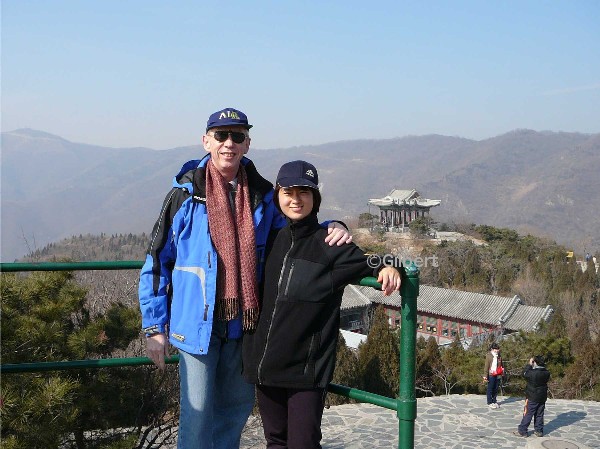
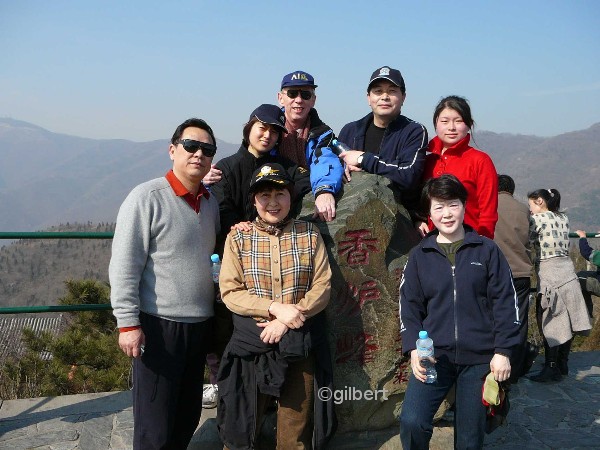

The winners: Gilbert & Valerie – part of the group who made it to the top – looking down at pollution
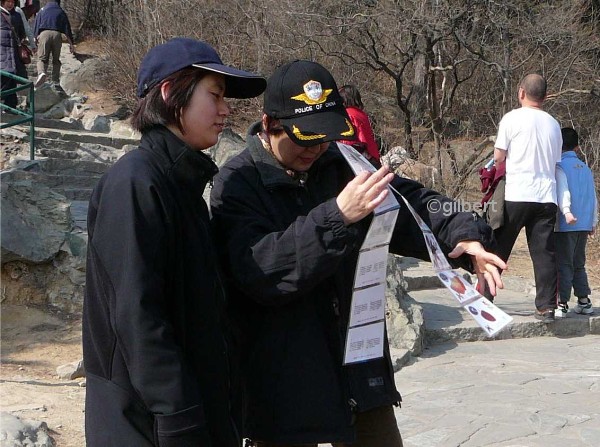
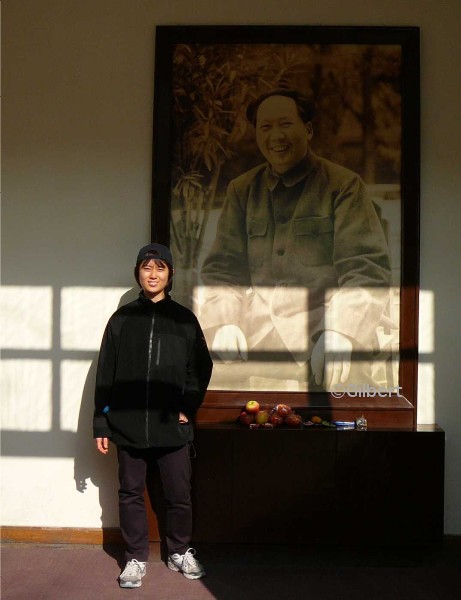
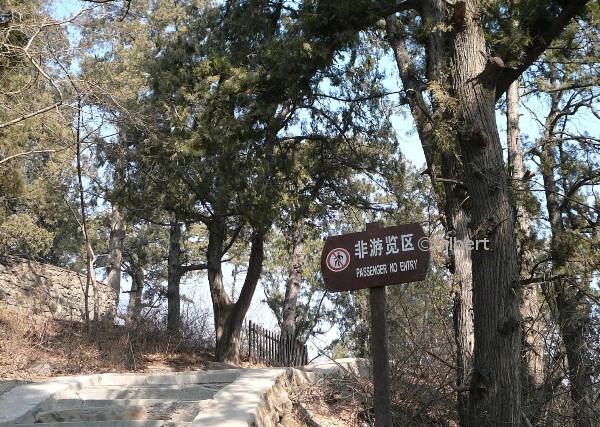
the “Police” checking local souvenirs – Valerie at Mao’s former residence – Chinglish in the park
Chinese construction workers: long way to go
If you have ever been faced with construction or renovation here then you are familiar with the nightmares. Most Chinese workers are full of goodwill but have no clue what they are doing. They are badly paid and training is non-existent. So no surprise if your nice walls crack after a couple of months, the plaster comes down from the ceiling after one year and the walls have zero insulation.
My father was a real expert mason and bricklayer and he would have a heart attack (translation: he would curse like a bricklayer does in my country) seeing the miserable quality of work.
See here a typical example of a “Chinese wall”.
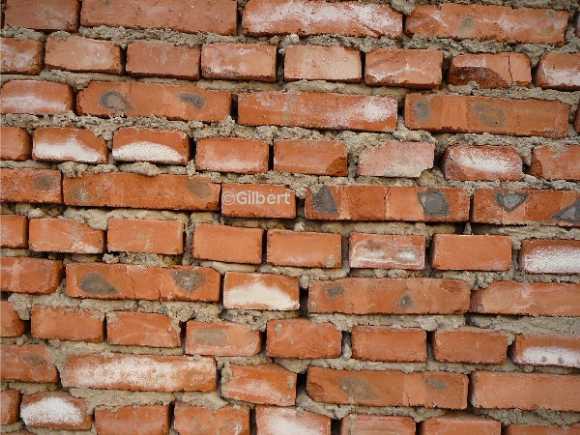
I argued with the bricklayers who gave the silly explanation that it was the right way to do, so when later covering the wall on the mortar would stick better. Go tell that somebody else, not to Gilbert the son of a real mason. It is just the contrary, you have to put excess mortar between bricks and scrape the excess off. If the mortar does not adhere to the wall it is because the mortar is of the wrong mixture – and you have to first wet the wall. Doing it the Flemish way you can’t get the mortar off later on.
So, if you wonder why you can hear your neighbor snore or the wall is so cold in winter that condensation dissolves the “plaster” and you can harvest mushrooms, don’t be surprised. Of course most “specialists” have no clue how to (correctly) make an insulating wall.
What China needs are more vocational schools and more respect for its workers. And pay them better. Then you’ll avoid the every-two-years-needed repairs.
My wife still hasn’t gotten the message. Maybe she needs vocational school too. She argues (Chinese wife style, does that sound familiar to you?) well “that’s China”.
Funny people some Chinese. A Mercedes has to be perfect and cannot break down. But Chinese construction is by definition poor. Way to go.
Valerie’s birthday – 21 February
A quiet celebration, just the three of us. Valerie has plans to celebrate in style on another day…



Valerie’s choice for her day was straightforward as usual: lunch in a Japanese restaurant (Capital Group Mansion), her favorite. Sun gave up at the end – too much food for the set lunch for “3 to 4 people”. Guess it was enough for five. Good thing those “da bao” (doggie bag), nothing is wasted!
Children rights: India versus China
Some days ago in my work with UNICEF the issue of children’s rights and slave labor came up. My comment was that I did not really feel this was a major issue in China. Sure, there are problems here but I don’t think it is a priority among the issues affecting China.
An article dated 19 February in the IHT gives some insights in the situation in India where the government is trying to enforce the Chile Labor Law but faces little progress. Official government figures estimate about 12 million children under 14 are employed – often under real slave conditions. Others estimate the figure could be closer to 60 million. It is a lucrative business and many girls end up in prostitution.
At the same time the Deccan Herald (Bangalore, India) reported 47% of Indian children are malnourished against 8% in China. (IHT 20 February)
So, China is doing quite well here. We are even facing serious obesity among the young in China and the need for more physical exercise.
Positive news should be reported too.