2 May 2006
Just a couple of days ago my daughter’s PC died. It wasn’t that bad, some chip got tired and needed replacement. She did not lose any data but is was a warning – the May holidays are a good time to back up the many GB in my iMAC.
Yep, I live (rather happily) on my Apple island in the office, all others use PC. I never managed to work on those. When I travel I can use them for some work as long as it is simple stuff like e–mail and the usual MS Office.
I am indeed one of those loners, no PC and certainly not Outlook and Explorer (Yuk – who that live with that stuff?). Netscape is still great, forgotten and even ridiculed. But on MAC OS X it runs great, in one program you have Explorer, Outlook and (mini) Web Design. I edit webpages before I print them or save them as PDF. Try that with that Explorer. Finally MS has decided to modernize their old stuff called Explorer, now the Beta version is available. I use only Explorer for narrow-minded websites that think the only browser in the world is IE. Our website is tested with several browsers and OS platforms. Nothing that spectacular, only requires a bit more work.
I just downloaded Firefox. Works just like Netscape and runs well. Safari is also good. But Netscape remains my default program at least as for now.
Doing the back-up is not really your dream of spending a holiday. My MAC OS 10.3.9 needs the new 10.4, since one year sitting on the shelf and you never know what happens with an upgrade. Hopefully the new OS will improve some of the pesky OS X little problems. First I thought my MAC wasn’t right but then reading on the Web, I wasn’t the only one.
Downloading on a PC external HD is a good test to see if all files are OK, names are correct and folders do not have those irritating hidden files, messing up downloads.
I finally understand (?) the simple ABC of names: the PC disk hates any “/” in a folder name. I mostly thought the file names were too long or contained those “special characters”. Well no, I did a “Find” search for files with a /, changed those to _ and there we go without problems.
Well not entirely.
Even MAC external disks were complaining about some of my folders while at first there seemed nothing wrong. I found the (unexplained) problem: some folders have the invisible files “_Icon”. That’s the bad guy.
With Find File plus the additional setting “invisible files” I got the list of the bad folders, not that excessive, some 25 in total. Trashing the Icon in the Search Results did not work. The solution was Norton Antivirus, “View Files” and show invisible. You look for the bad folders, find the Icon and trash it within Norton. Works and then the downloads went fine. I am still not clear if the trash is really emptied – Norton sees still some of those pests in the trash while the desktop trash folder is empty.
But real pesky are those zillions of new files created by OS X on PC disks, serving no purpose at all: all files are joined by namesakes preceded by _ and DS_Store in all folders. I have thousands of pics – on the PC disk they just double in quantity… They confuse, take up space and are a pain to delete if you want to do it, what I mostly do in a PC or on my good old PowerBook with OS 9. Apple can say what they want – I loved OS 9 and keep as a treasure my old PowerBook. At least I could understand what OS 9 was doing – OS X sometimes makes me wonder if we are being led into PC world by force. Or maybe I am getting too old. Well, till now I have not seen one MAC guru who really knows what all that stuff is in OS X “you don’t need to know, if it does not work just re-install the OS”. Great. Sounds like my PC people in the office: about once a month the PCs (with Chinese OS) need some “reloading”. They say it’s normal, also PC crash is said to be normal (at least in my office – not really a reference). We Macfanatics are NOT used to that.
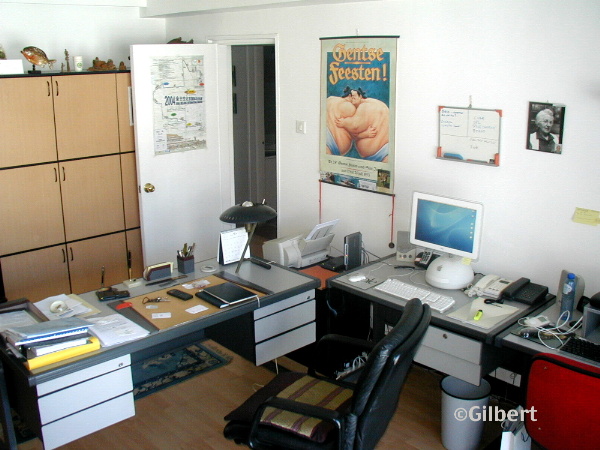 the office of one more Macfanatic, in Beijing
Hopefully OS 10.4 will be better….
Comments from gurus and alike are welcome. I am NOT one, I just try to survive…
Beijing’ population; Wal-Mart and PCs
2 May 2006 – holiday period
The best kept secret seems to be – how many people really live in the Beijing Municipality?
I have been checking any figure published in the official press. Most are misleading and contradictory, once you know what to look for.
Finally, in the April edition of the magazine BusinessBeijing (one of my favorite), I found an overview I can give a stamp of credibility. The official population in 2005 was 15.36 million – in 1949 it was 4.2 million. The outlying rural regions count for 16.4% or 2.52 million. Now comes the interesting part – it does not include the more than 4 million migrant workers without a residency status.
In other words, the real total would be about 20 million. Now you know.
China’s total population on 1 November stood at 1.306 billion according to the National Bureau of Statistics.
Wal-Mart China will hire up to 150,000 employees over the next five years – five times the current work force. It has now 30,000 employees and 56 stores – 20 more to open this year.
China will produce 98 million desktop and laptop computers in 2006, 58 million for export. Roughly, production goes up 20% every year. Check the lable on your PC when you go shopping next doors to Wal-Mart.
China the land of plenty money – fried worms on the menu
2 May 2006 – yeah yeah, holiday?
Seems not all Chinese are born equal. If one has too much money, some tips on spending it: Shanghai has some expensive villas for sale in Shimao Sheshan. The top one goes for US$ 31.25 million or RMB 250 million. “Smaller” ones go for RMB 50 million. Four years ago a similar one was sold at RMB 140 million. The record goes to one in Xijiao – 150 million. Shanghai saw sales of villas in 2005 at a rate of 6,308 units, good for 1.54 million sqm. The buyers: mostly Shanghainese or Hong Kong businessmen.
How to spend the “Golden Week” here for the May 1 holidays (May 1 to 7)? Just trying to catch up with work and working on the MAC – back-up, cleaning up files and folders. Hopefully I will be able to update some of the software.
The workers next door at the always-under-construction building also decided to work even harder and started banging and dropping metal pipes at 6 am. Hard workers those guys. Pity they always drop pipes. Maybe it’s a sport or they are slippery. Never found out what they are actually doing.
Our friend Xiao Yu (Ms.) has moved into her new apartment, above our new one. Hers is already looking good – ours still needs some final touches. So, the girly gang is shopping till-you -drop-dead.
We have experimented with some of the new restaurants around us, one Korean (in our Julong compound) and a Chinese one with Yunnan food across the street. I had enough courage to taste the fried worms (bon appetit!) but Xiao Yu apparently wasn’t as Chinese as I am… The worms are crispy, good for the health (all food in China has some health benefits it seems, the weirder the better).
The weather has changed from sandy and dusty to plain dusty and warm – over 25C. The “stick trees” that Sun brought into our compound are starting to grow. They are, well, like big sticks, over 4 meters high. Sun came in with two trucks of trees and other plants – about 100 in total. Ten of them mysteriously disappeared when left alone – stealing here becomes rather common. Our “security guards” of the compound had of course not seen anything (why am I not surprised?). That’s our contribution to the “Greening of Beijing”.
Talking about money: There’s More to Gain from Binary Trading
Wikipedia: not behind the New Internet Great Wall
Some years ago Wikipedia was still on line here and I found there some interesting information, such as the development of the Beijing subways. Not anymore. Seems some bad people posted reactionary stuff on that site so we are being shielded from harm by the Chinese Great Internet Firewall. Thanks to US technology. Very sophisticated technology, the usual proxies won’t work anymore.
The Wall makes our daily Internet life a misery. Working for the Beijing government I often need to surf the net for information – a skill most (local) Chinese are not so good at, for some strange reasons. They manage quite well to surf on Chinese sites but seem lost when digging for useful information internationally.
Several overseas companies have their websites blocked, for reasons that are not clear at all – like high-tech companies, recruitment agencies and others. How I know? Well, we do have some complicated ways to reach the sites, like surfing when abroad.
The worst is: the filtering officially does not exist and certainly NOBODY is in charge. So, no way to complain or ask for review of the censorship.
Internet speeds here can be quite fast – as long as you remain within the Chinese island of the Web. Once you need to make downloads, have some tea, go for a walk. Download speeds can be anything, on a bad day 5KB/sec, a good day 50 KB/sec and if you a real lucky 80 kb/s and more – all on ADSL.
I have been running exhaustive tests to pinpoint the bottlenecks. As far as I see, the major ones are:
– the traffic to the USA goes through too few international Internet gateways;
– the bandwidth in the submarine cable systems is too small;
– the filtering system adds to a considerable slowdown of the signal;
– the transmission (heavily concentrated) lands into a congested US network where technical breakdowns regularly occur;
– China does not have good enough contracts with US operators to use their networks.
China Netcom has been quite understanding at times, they invited me for meetings to see what could be done. They promised the bandwidth will increase – but as long as there is no new major China-USA submarine cable plus better operator agreements, hope is rather limited…
Just recently, after several days of tests, I had to admit myself the filter does indeed slow down traffic and I finally solved the mystery of e-mails that could not be downloaded from a US server to a mail program. I tried all mail programs – normally I use good old Netscape (still GREAT): (Mac) Mail – Entourage – Thunderbird. PC and MAC, whatever operating system: all suffer the same fate: during the download of certain messages the program gives up, blocks and frequently the server mysteriously becomes unavailable from all computers: that is the typical feature of the filter when you handle “unauthorized” messages. After some time, the server is back on line again.
(Nope, I don’t use Outlook!)
It looks like a software or settings issue of the filter – the e-mails are nothing special… the usual victims are the mails from Amcham, the Canada Business Council and others. Seems the trigger is in the first lines of the message: there should be no “funny” images, e.g. linked to a website or with animation, something like that.
The suffering merits no attention from any of the chambers of commerce here. They all lack the guts to bring up the issue, with a variety of lame excuses: “too technical”, “taboo”, too busy, not our concern. Those so-called “IT gurus” I meet here all have their expert theories, mostly they have no clue or pretend not to understand. So most bury their head in the sand, and as we have lots of it in Beijing, that’s easy.
The big companies here have money to pay for expensive IT systems with dedicated lines, special servers/routers and don’t care about us small companies who can just afford ADSL. Happy to learn big Shell also suffers from the same problems. I also know a German bank that is struggling to get their mail – from Germany directly, not from a US server.
The time I lose with all that crap is unbelievable. While it is said the Chinese have a force of 50,000 to check the Net for “bad stuff” (I wonder who came up with that information) I am flooded with SPAM every day, mostly on the local ISP e-mail account. Total of about 150/day on the average. While I do have SPAM filters I still check all mails – the SPAM filters are not reliable anyway. Once again, China could really do something about SPAM but it is not a priority as it seems.
What is considered “bad” by the Internet Wall? Well… sex is OK, so are scams. Certain “evil sects” are bad, as we all know. The Wall still does not a good job though – we are still regularly harassed by those guys, by (taped) calls and e-mails.
iTunes in France – the draft Labor Law in China
Here we urge the authorities to allow a smooth development of new technologies through efficient protection of Intellectual Property Rights.
In France they are giving a bad example, setting the clock back by a bill that would require Apple to open its software codes of its iTunes Music Store.
I am very happy with iTunes and use two iPods. Great fun, I have downloaded nearly all my CDs and have nearly 7 days of uninterrupted music. No access to the Music Store yet in China. The iPod helps me in my running in the gym: last Saturday I run 15K on the treadmill in 90 minutes. Kind of boring without the music. Last Marathon in Beijing I even used the Nano I bought a couple of days before the race.
Why people love the iPod and iTunes? Because it is a good product. France should go after companies that make bad products, not the ones that innovate and make consumers happy.
As commented in the IHT, the French short-sightedness could result in other countries forcing French companies to open their “codes” – e.g. in electronics, biotech and telecom.
Once again France is setting a bad example.
I just don’t get it how all those clever people in France can come up with such ridiculous ideas like the 35 hours week and the rest. The Chinese must be happy with the French – now they have good excuse to ask foreign companies to open their technology secrets. Even the new Chinese draft Labor Law looks like it was a direct import from France. If approved the new law will take away all flexibility from the labor market. Another consequence: it will encourage companies to steal staff from competitors: the employees can take along all the technology and management expertise as the penalties to be paid are peanuts.