You can just wonder what are all those special stones on the walkways. Well, they are supposed to help the blind people. Pity all people with disabilities in China. The State Council just announced last week a “formula of hope”, a five-year program, for all Chinese citizens with disabilities. There is certainly a need. Access to buildings for the handicapped is mostly incomplete and the special ramps are more than often blocked. Not to wonder you don’t see many handicapped people on the streets nor in office buildings. I just wonder where they are. Chinese people have a tendency to “hide” those people, I have the impression they still feel they are not a good image if shown in public. Companies even feel it is not good for their image to employ people with disabilities. In my own building I could never employ or receive people with disabilities – there is simply no elevator.
As for the special guide stones on the walkways, forget about them. The strips mostly lead to nowhere and are blocked by cars parking on the sidewalk, vendors or as pictured here, by bikes. Nice to have bikes, Green Beijing. But not for the blind.
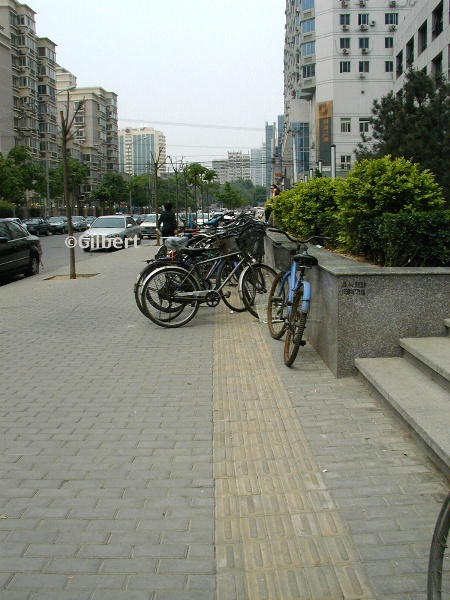 Xinzhong Street, Dongcheng District. One of the many examples.
How will Beijing do during the Olympics? Maybe they can invite the press at some “show case segments” where it looks all right. But in the majority of the walkways, it is simply a no-go.
I really hope the new initiative of the State Council will not be limited to lip service.
On the other hand, the special tiles are a good idea. Must say, never seen this in Belgium…
China CEO – Voices of Experience
On Friday 26 Amcham organized an interesting presentation by one of the authors of the book, Ms. Laurie Underwood and also Mr. Kenneth Yu, managing director of 3M China Region, one of the CEOs interviewed. Both were excellent speakers and communicators.
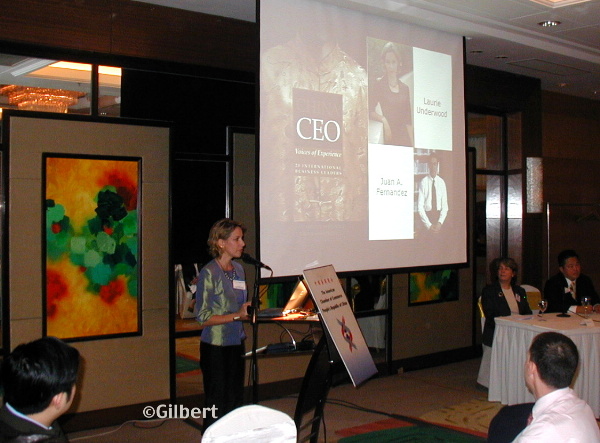
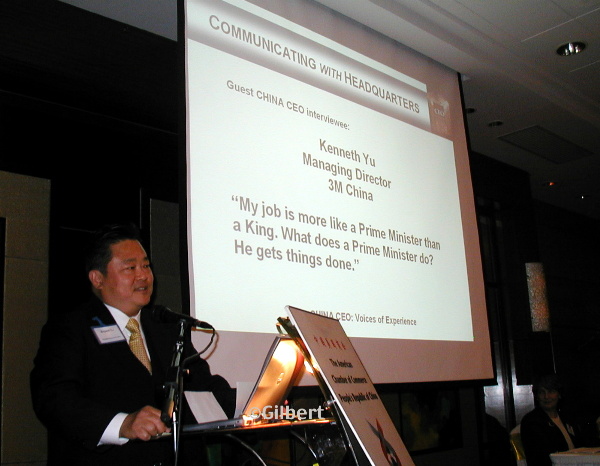
Laurie and Kenneth at the the Kerry Center
About every week a new book is coming out on China. Many of my friends urge me to write my own book and I ask myself if it makes sense to add one more to the list. People who have been 6 months or 10 year over here feel compelled to explain to the world their deep insight in this fascinating country. Some authors succeed to focus on interesting areas, many however just list the usual generalities on how to enter the “vast market” or come up with questionable views on the market potential for foreigners or come up with disaster scenarios. So, what should I possibly write about? Question unanswered as for now.
The Amcham presentation was looking into one – important – aspect of working here: “Closing the China-to-Headquarters Communication Gap”. My experience can only confirm some of the comments during the presentation: I mostly felt it was harder to deal with the headquarters than with the Chinese. And still today, with all the information available through the media and the Internet, even well educated westerners have a poor knowledge of what China really is today. A big cultural gap filled with misconceptions, misinformation and unrealistic expectations. Not to speak of the usual lack of effort and patience to understand a world that is so different from ours. Bridging that gap with your bosses thousands of Km away is a real challenge.
The book has the merit that is based on factual research, interviewing about 20 CEOs of Fortune 500 companies in China. As far as I can see, some valuable feedback. I happen to know some of them quite well, so I am very curious to find out how they are presenting their story. Let’s be clear – I did not read the book yet. Knowing how some MNCs manage to project their wisdom and professionalism to the outside world while internally things are often a accumulation of personal interests, infighting and plain incompetence it is always interesting reading how they show their colors to a wider public. Maybe I have been looking too much to the inner workings of several MNCs…
What I already see missing in the picture is the absence of some non-western CEOs. Only one Japanese CEO is featured, not by oversight of the authors but because – as I know – those are reluctant to participate in such a project. I have been looking into the way South Koreans companies operate in China (no CEO from that country could be interviewed). They have very different strategies than our western companies. Just take note – South Korea is the third de facto trading partner of China (China Daily!). I met some of those Korean executives, not exactly the open and social type of executives, a bit like the Japanese. But they are very successful, using a nearly totally different management style. Maybe more about that in my book. Some day, who knows.
The progress of Olympic construction in 360º
In Beijing it is very difficult to get good information on the progress of the construction of the Olympic venues. Even high-level delegations are mostly denied access to the construction sites in the Olympic Green, journalists are mostly frustrated they cannot get a bit closer. Sometimes they have the “honor” to be driven around for a quick tour and can only make pictures through the windows of their mini-bus.
Beijing is working day and night on the venues and progress is impressive – some of the venues are also unique from an architectural point
Peter Danford, a good friend by now but also an excellent photographer, has managed to shoot some exceptional and breathtaking pics of the construction at the Olympic Green. Even the more exceptional as it was done on one of these rare days without pollution: you can see the mountains, a real treat. See his site:
http://thebeijingguide.com/olympic_construction/beijing_olympic_construction.html
It may seem easy to get somewhere to a high building and shoot panoramic views. Just try and you will appreciate it even more.
Exploring his website you will find some other rare 360 degrees pictures. Just sit and enjoy while he slowly turns around his camera.
Olympics 2008 – briefing on “Temporary Venues” in the new BOCOG
The preparation work for the Beijing 2008 Olympics is often criticized by businessmen and by the foreign chambers of commerce – the tendering process is not so open and transparent and information is very difficult to get. In the Working Group “Public Procurement” of the European Chamber in Beijing (EUCCC) we look at how the government is dealing with tenders of public projects, including the many projects to modernize Beijing. (I am the chairperson of the Group)
On 10 May a wide group of interested companies attended an information meeting in the new building of BOCOG (The Organizing Committee for the Olympic Games). The building was opened in October 2005 and is located in the north of Beijing on the 4th Ring Road. The metro line 13 is not too far. The building is modern and pleasant.
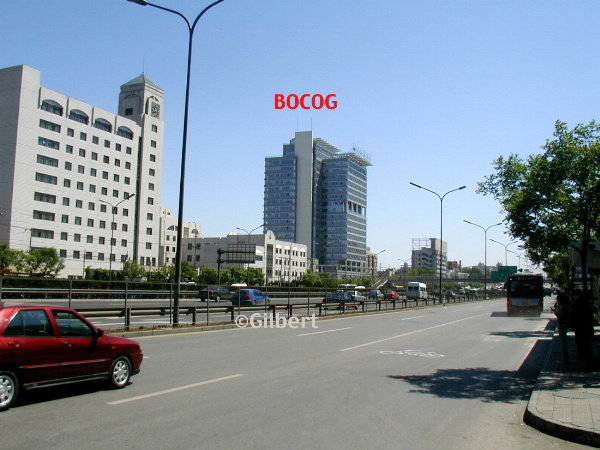
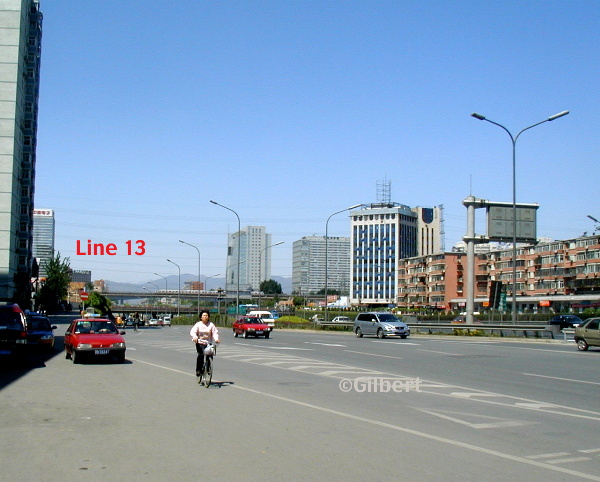
The BOCOG building on the 4th Ring Road (North) and to the west Line 13 (elevated)
The subject was a briefing on the plans for the “Temporary Venues” (sometimes called Overlay) and possibilities for sposorship. Positive was that rather complete information was provided and the presentation was given out as a hard copy.
Unfortunately, the speakers decided to give the presentation in Chinese, rather embarrassing as many delegates were flying in from Germany, Switzerland, France, UK and other locations. The poor foreigners could just sit and wait to get to their office and translate one of the presentations into English – the other one was in English and Chinese (so we did too).
Beijing pretends some 30% of the citizens can handle some basic English. Well, I still did not find them. No any taxi driver I ever met can understand English… while it is said they are receiving English lessons…
At least BOCOG could do an effort… Not that I criticize them too much because many of the staff are trying their best to cope with the workload. But they face their limitations in staffing.
At least is was a good step forward for BOCOG in their communication with the foreign business community.
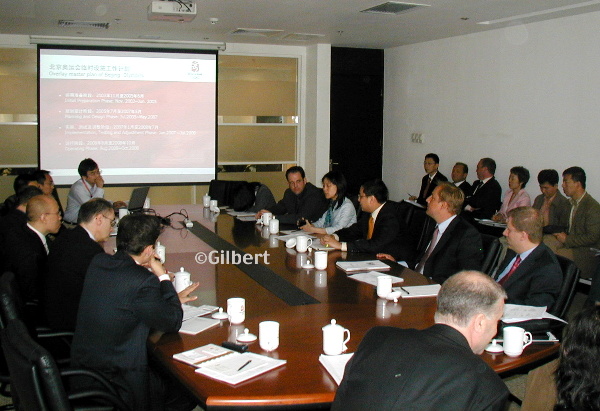
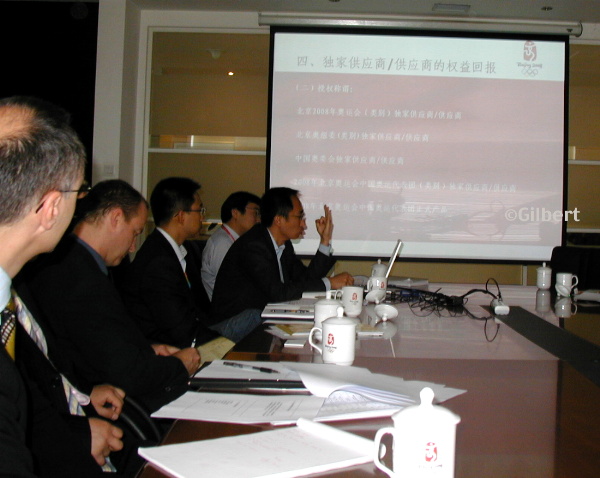
The largely foreign audience … listening to the Chinese presentation
Belgians doing charity in China
Quite a number of foreigners living in China are involved in charity work. Even Belgians!
Since over a year I am now an active member of the Beijing Rotary Club – we have nearly 60 members, as a result of local regulations we can have only foreigners as members. The Club is involved in many charities. Further information: see the website www.rotaryclub-beijing.org.
On 9 May we had as guest speakers Koen Sevenants and Pierre Schavey from the Morning Tears Charity, based in Belgium, introduced by myself. They explained their program to help children in China whose parents are in jail or have been executed. The charity supports a children’s village in Xian with 49 children. It especially helps with counseling for children suffering from trauma. Eventually, the organizers hope that the government will take charge of the problem. A benefit event will be held at the Belgian embassy on June 10. Further details can be found at their website www.morningtears.com.
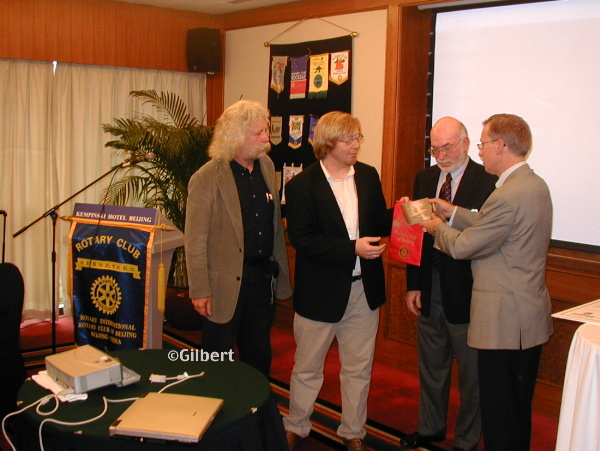
From the left: Pierre and Koen receiving the Beijing Club banner from our president Carl-Ludwig Doerwald, on the right.